A Complete Guide for Homeowners
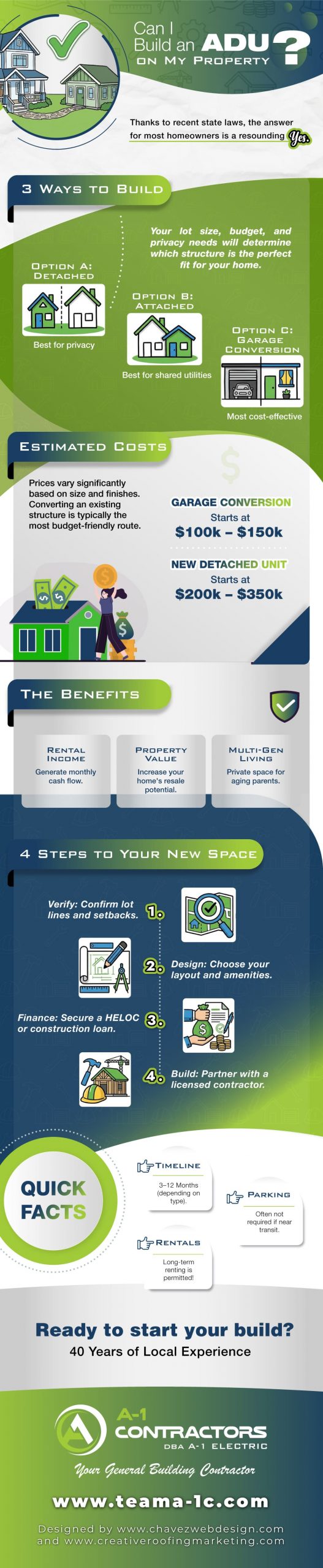
As housing needs evolve, many homeowners in California are seeking ways to optimize their living space. You might be dreaming of a private suite for aging parents or a rental unit for extra income. Naturally, the first question you likely have is: can i build an ADU on my property?
For most homeowners, the answer is a resounding yes. Recent changes in state laws have made it easier than ever to add an Accessory Dwelling Unit (ADU) to your land. Whether you are looking into full-scale home remodeling or a simple garage conversion, understanding the basics is the first step.
Understanding the Basics of ADUs
An ADU is a secondary housing unit on a single-family residential lot. They are often referred to as granny flats, in-law suites, or backyard cottages. They provide independent living facilities complete with a kitchen, bathroom, and sleeping area.
California state laws have overridden many restrictive local ordinances to encourage ADU construction. Generally, if you have a residential lot, you have the right to build. However, you must still adhere to building codes regarding setbacks, height limits, and safety standards.
Choosing the Right Type of Unit
Once you determine that you can build, you need to decide on the type of structure. The design you choose will depend on your budget, lot size, and existing structures.
- Detached ADU: A stand-alone structure separate from the main house. This offers the most privacy but often requires the most construction work.
- Attached ADU: An addition connected to the primary residence. This is a great option if you want to share utility connections easily.
- Garage Conversion: Transforming an existing garage into a living space. This is often the most cost-effective method.
If you are unsure which type fits your lot, consulting with professional general contractors is essential to evaluate your property’s potential.
What Does an ADU Cost?
Cost is a major factor for any construction project. While prices vary wildly based on finishes and size, having a ballpark figure helps with planning.
A garage conversion is typically the most affordable entry point. These projects often range between $100,000 and $150,000, depending on the condition of the existing structure. Because the shell is already there, you save on foundation and framing costs.
Building a brand-new, detached ADU usually costs more. Prices for a standard 500 to 800-square-foot standalone unit often start around $200,000 and can go up to $350,000 or more for luxury finishes.
Designing for Comfort and Value
To make your ADU livable and valuable, the interior design must be efficient. Since ADUs are smaller than standard homes, every square foot counts.
You will need a functional culinary space. Professional kitchen remodels for ADUs often utilize open shelving and compact appliances to keep the space feeling open.
Similarly, the restroom requires smart design. Modern bathroom remodels in these units often feature walk-in showers and clever storage solutions to maximize utility without cramping the room.
Navigating Financing Options
Once you know the costs, you need to figure out how to pay for them. Fortunately, there are several ways to fund your project.
Many homeowners utilize a Home Equity Line of Credit (HELOC) or a cash-out refinance. These allow you to borrow against the equity of your main home. There are also construction loans specifically designed for building accessory units.
If you are worried about the upfront investment, check our page on financing to see what options might be available to help you get started.
Why Experience Matters
Changing regulations can be tricky to navigate alone. While the state says “yes,” local cities like Visalia, Fresno, or Tulare may have specific submission requirements.
Working with an experienced builder ensures you don’t get stuck in permit purgatory. You need a team that understands not just construction, but the specific legal landscape of the Central Valley.
For detailed information on state standards, you can review the California Department of Housing and Community Development’s ADU Handbook, which outlines your rights as a homeowner.
Partner with A-1 Contractors
If you are still asking, “can i build an adu on my property?” let us help you find the definitive answer. At A-1 Contractors, we have nearly 40 years of experience serving the Central Valley.
Founded in 1985, we have grown from a lighting specialist into a premier general contractor focusing on ADUs and custom remodels.
Our mission is to enrich our community through expert design and craftsmanship. Whether you are in Visalia, Kings, or Kern County, our family-owned team is ready to bring your vision to life with integrity and transparency.
Frequently Asked Questions
Does adding an ADU increase my property taxes?
Yes, but typically only partially. The tax assessor usually adds the value of the new construction to your existing assessment. They generally do not reassess your entire property, so your base tax rate on the main home often remains the same.
How long does it take to build an ADU?
The timeline varies by project type. Garage conversions can often be completed in 3 to 6 months. New detached construction may take 6 to 12 months, including the time required for design, permitting, and construction.
Do I need to provide extra parking for an ADU?
In many cases, no. State laws have significantly reduced parking requirements. If your home is located within a half-mile of public transit, you generally do not need to add new parking spaces for the unit.
Can I rent out my ADU?
Absolutely. One of the primary benefits of an ADU is the potential for rental income. While rules on short-term rentals (like Airbnb) vary by city, long-term rentals are almost always permitted and encouraged to help alleviate housing shortages.
What is the maximum size I can build?
State law generally allows for ADUs up to 1,200 square feet for detached units. However, this can depend on your local city’s specific ordinances and your lot size. Attached units are typically limited to 50% of the size of the existing primary dwelling.
For a comprehensive overview of the latest ADU laws, regulations, and potential financial incentives in California, always consult the official resources provided by the California Department of Housing and Community Development.